
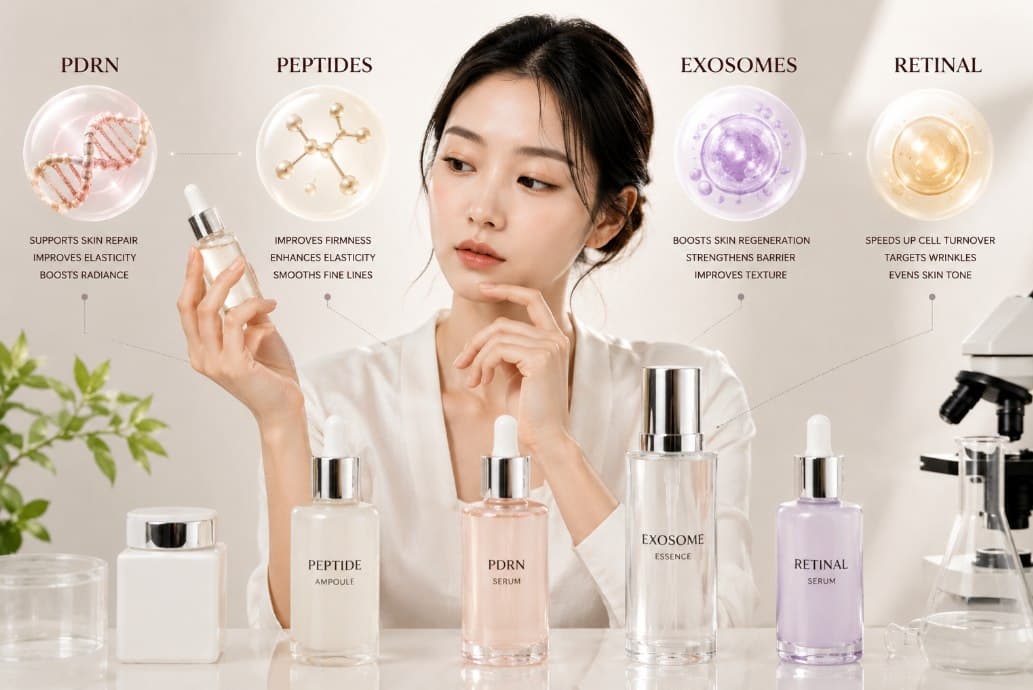
The skincare industry has entered a new era where ingredients often have more influence than brands. Today’s consumers are increasingly educated, researching formulations before making a purchase and actively searching for products that target specific concerns. Terms like PDRN, peptides, exosomes, and retinal have become familiar to beauty enthusiasts, and many shoppers now choose products based on these actives rather than packaging or marketing claims.
For retailers, distributors, and beauty businesses, understanding which ingredients are driving demand is essential. While every ingredient has its own strengths, their popularity varies depending on consumer awareness, product positioning, and market maturity.
So, which ingredient is currently leading global sales, and which ones represent the biggest opportunity for future growth? Let’s take a closer look.
Why Ingredient-Led Shopping Is Changing K-Beauty
Just a few years ago, customers typically asked for a favorite brand. Today, many enter a store or search online looking for an ingredient instead.
This shift has been fueled by social media, skincare influencers, dermatologists, and consumers who want to understand what they’re putting on their skin. Ingredient transparency has become a major purchasing factor, and shoppers increasingly compare formulas before making a decision.
Instead of asking, “Which moisturizer should I buy?” customers are asking:
- Does it contain peptides?
- Is it formulated with PDRN?
- Does it include retinal instead of retinol?
- Is it suitable for a damaged skin barrier?
For retailers, this means product education has become just as important as product availability. Brands that clearly communicate ingredient benefits often perform better because consumers feel more confident in their purchasing decisions.
PDRN – The Fastest-Growing Premium Ingredient
If there is one ingredient that has defined premium Korean skincare over the past year, it is PDRN (Polydeoxyribonucleotide).
Originally associated with professional aesthetic treatments, PDRN has rapidly expanded into everyday skincare. Consumers are attracted to its reputation for supporting skin recovery, improving hydration, and promoting healthier-looking skin.
Unlike many trend-driven ingredients, PDRN fits perfectly into the growing movement toward skin longevity and barrier-focused skincare.
Consumers are especially interested in PDRN because it is associated with:
- Supporting the skin’s natural repair processes while helping improve overall skin comfort, elasticity, and hydration over time.
- Complementing modern routines focused on prevention rather than aggressive correction, making it appealing to consumers interested in maintaining healthy skin for the long term.
From a retail perspective, PDRN products often occupy the premium segment, allowing businesses to offer higher-value skincare solutions while meeting growing consumer demand.
Peptides – The Reliable Bestseller

While PDRN is generating excitement, peptides remain one of the most stable and trusted ingredient categories in skincare.
Rather than relying on a single trend, peptides have evolved into a long-term staple because they appeal to a wide range of consumers. From preventive skincare in younger adults to mature skin routines, peptide products fit almost every age group.
Another advantage is that peptides combine well with many other ingredients, making them highly versatile in formulations.
Consumers typically choose peptide products because they help:
- Support smoother-looking skin, improve firmness, and maintain overall skin resilience without causing significant irritation.
- Fit comfortably into daily routines thanks to their gentle profile, making them suitable for consistent, long-term use.
For retailers, peptides represent one of the safest investments because they have broad appeal and generate repeat purchases across multiple product categories.
Exosomes – The Innovation Everyone Is Watching
Exosomes have quickly become one of the most talked-about technologies in skincare.
Although consumers often associate exosomes with regenerative medicine, skincare products inspired by exosome science are attracting increasing attention because they represent innovation and advanced cosmetic research.
While awareness is still developing compared to peptides or retinal, interest continues to grow rapidly among premium beauty consumers.
Exosome-inspired skincare is particularly attractive because it is positioned as part of the next generation of cosmetic science.
Businesses should remember that consumer education plays a significant role in this category. Since many shoppers are still learning about exosomes, clear product explanations can strongly influence purchasing decisions.
Retinal – The Smarter Alternative to Retinol
Retinal has become one of the most exciting anti-aging ingredients in Korean skincare.
Many consumers who previously used retinol are now exploring retinal because it is often recognized as an effective vitamin A derivative while fitting well into modern skincare routines when formulated appropriately.
This shift reflects a broader trend toward maximizing performance while minimizing unnecessary irritation.
Consumers increasingly appreciate retinal because it is commonly featured in products designed to:
- Improve the appearance of fine lines, uneven texture, and skin tone while supporting smoother-looking skin through regular use.
- Deliver advanced anti-aging benefits in formulations that are often combined with barrier-supporting ingredients such as ceramides or panthenol.
Retailers can position retinal products as part of a premium anti-aging collection that appeals to consumers seeking scientifically backed skincare solutions.

In terms of current global sales, peptides remain the most established category because they appeal to nearly every customer segment.
However, PDRN is experiencing the fastest growth, particularly within premium skincare collections.
Exosomes represent the greatest long-term opportunity, while retinal continues to strengthen its position among consumers seeking advanced anti-aging solutions.
How Retailers Can Build a Winning Ingredient Portfolio
Instead of focusing on a single trending ingredient, successful retailers create balanced product assortments that appeal to different customer needs.
A well-rounded portfolio might include:
- Barrier-supporting products featuring ceramides, panthenol, and Centella Asiatica to attract consumers with sensitive or dehydrated skin.
- Premium innovation products featuring PDRN, peptides, exosome-inspired technologies, and retinal to meet growing demand for advanced skincare and higher-value purchases.
This strategy allows businesses to serve both entry-level customers and experienced skincare enthusiasts while increasing opportunities for repeat purchases.
Another important consideration is education. Many consumers understand ingredient names but still need guidance on how they work and who they are suitable for. Retailers who provide clear, science-based explanations often build stronger trust and higher conversion rates.
The Future of Ingredient-Led Skincare
Ingredient-focused shopping is no longer a passing trend, it has become a defining characteristic of the modern beauty industry.
Consumers want transparency, effective formulations, and products that align with long-term skin health rather than short-lived hype. As a result, ingredients like peptides, PDRN, retinal, and exosome-inspired technologies will continue shaping purchasing decisions across global markets.
For retailers and distributors, success will depend on balancing innovation with proven bestsellers. Offering a carefully selected range of products built around high-demand ingredients not only strengthens customer confidence but also creates opportunities for higher repeat sales and long-term business growth.
Partnering with an experienced korean skincare wholesale exporter gives businesses access to innovative formulations, trusted Korean skincare brands, and the latest ingredient-driven products that meet evolving consumer expectations worldwide.
B2B sourcing next step
Use this ingredient discussion as a starting point for product research, not as a confirmation of current availability, territory suitability, pricing, or documentation for a specific item.
Browse Featured Brands for a starting selection. For minimum order, payment, shipping, and export-document questions, read the Wholesale FAQ.
For a practical availability and quotation review, use the Wholesale enquiry form and include the brand, item name or product link, and estimated quantity.